Wednesday, January 2, 2019

WHOSE BABY IS THE NEW CONSTITUTION?

DFT-15-6

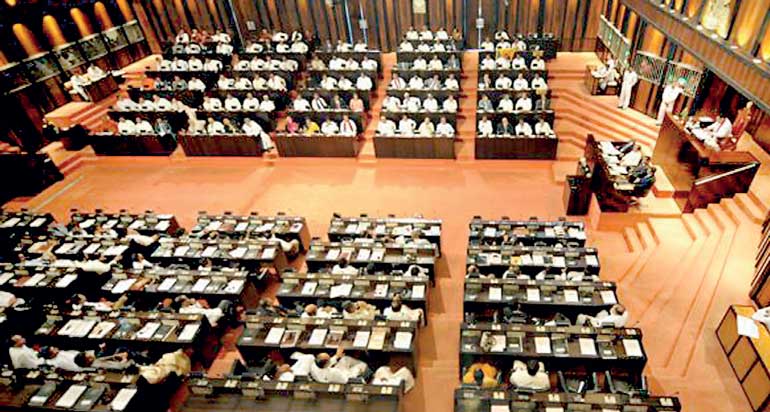
This Government has taken several important steps towards the new constitution. As the first step of the process the Government established the Public Representations Committee on Constitutional Reform headed by Lal Wijenayake. After conducting number of sessions of public consultations the Committee issued the report in May 2016. Thereafter the Parliament met as a constitutional assembly with the powers of Parliamentary Select Committee to draft the new constitution.

There are 21 Members of the Parliament in the Steering Committee of the Constitutional Assembly which is headed by the Prime Minister. The purpose of this Committee is to prepare the draft constitutional proposals. The Steering Committee wanted further public consultations and based on those Public Representations Committee published another report in July 2016. 

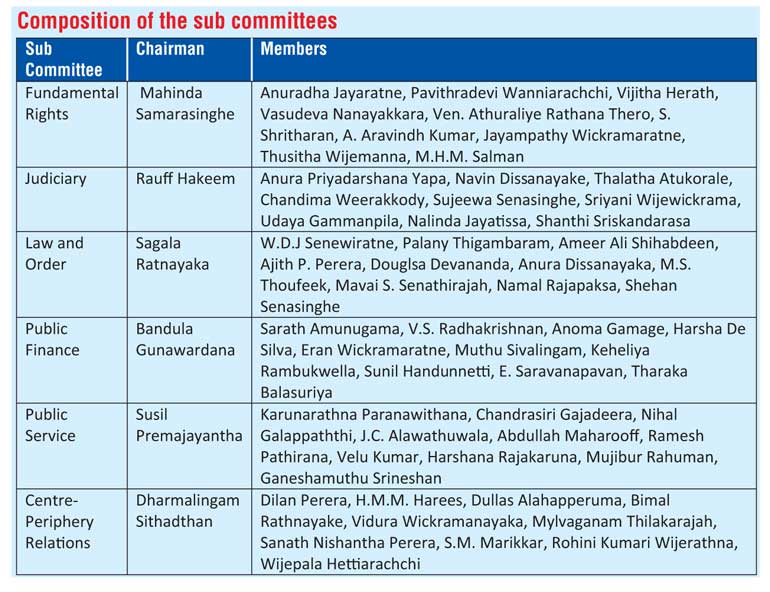
In May 2016 the Constitutional Assembly appointed members representing all parties in the parliament to six sub committees covering the areas of Fundamental Rights, Judiciary, Law and Order, Public Finance, Public Service and Centre-Periphery Relations to assist Steering Committee. All the reports of the sub committees are published now. The intention of all these sub-committee reports was to improve the productivity by devolving and at certain points centralising the power. However, the Steering Committee did not publish the draft constitution yet.


Steering CommitteeUntitled-1

The Steering Committee headed by the PM comprises Lakshman Kiriella, Nimal Siripala De Silva, Rauff Hakeem, Wijeyadasa Rajapakshe, Susil Premajayantha, Rishad Bathiudeen, Champika Ranawaka, D.M. Swaminathan, Mano Ganeshan, Malik Samarawickrama, R. Sampanthan, Dilan Perera, Dinesh Gunawardena, Jayampathy Wickramaratne, M.A. Sumanthiran, Thusitha Wijemanna, Bimal Rathnayake, Prasanna Ranatunga and Douglas Devananda.

It was decided by the Steering Committee that the Matters covered by Chapter 1 and 2 of the present Constitution, Nature of the State, Sovereignty, Religion, Form of Government, Electoral Reforms and Principles of Devolution and land will be dealt directly by the Committee.


Fundamental Rights

The report of the sub-committee on Fundamental Rights stated as follows. “The Bill of Rights which incorporate civil and political (first generation rights) economic, social and cultural (second generation rights) and environment and development rights (third generation rights). Some constitutions, which are noted for their progressive and innovative Bills of Rights, include South Africa (1997), East Timor (2001) Ecuador (2008), Bolivia (2009), and Kenya (2010).” The first generation rights are in the existing constitution and the sub-committee recommended to have second and third generation rights as well in the constitution. These days there is a debate on this. 

The issue is how to implement although those rights can be accepted in principle. Economic and social decisions should be taken by the Government and by including those into the constitution there is a space created for the Judiciary to interfere in governance about which Judiciary knows little. Hence it can direct the governance into a wrong path. 

Prior to include these rights to the law the society should come to that economic and social level. Thereafter those rights can be incorporated into the law. Social development evolves throughout an extended period and that development cannot be done overnight by court orders. We should not accept the developments in other countries as a fashion. Therefore law makers should be careful in this aspect.


Judiciary

Sub-committee on Judiciary reported that in the existing constitution there are no methodology defined to secure the independence of the Judiciary which is essential. It was also recommended that the judicial power of the people should be vested in the Judiciary rather than through the Parliament. We can remember how the Parliament tried to exercise judicial power soon after the 1978 Constitution was adopted. 

Sub-committee recommended that the judges of the superior courts should be appointed by the President on the recommendations by the Constitutional Council which has received nominations from a panel of former judges of the Supreme Court. This further limit the powers of the President and the Constitutional Council which is a welcome move. Sub-committee also dealt with the structure of the courts and recommended a Constitutional Court.


Law and Order

Sub-committee on Law and Order recommended that the Sri Lanka Police should comprise the Sri Lanka National Police and Sri Lanka Provincial Police. Sub-committee recommended the responsibilities of all three. Sub-committee also recommended a National Police Commission and a Provincial Police Commission and the responsibilities of those commissions. Responsibilities of IGP and Provincial Police Commissioners were also defined. Recommendations were also made about the National Security Council and the Criminal Investigations Department and the procedure to declare an emergency. 


Public Finance

Finance Sub-committee recommended that 25% of Government revenue should be allocated to Provincial Councils and Local Government Institutions, being 18% and 7% respectively. Also it was recommended that the Head of State should not hold the portfolio of Finance. In this aspect, we had several confusions under two Heads of State.  Recommendations were made in respect of the responsibility of the Parliament of Public Finance, structuring of the budget process, control over public expenditure, control over borrowing and contingent liabilities and marginalisation of provincial and local finance. Proposals were made to empower more the Auditor General and Government Audit.
DFT-15


Public Service

Sub-committee on Public Service has given various proposals in respect of the definition, values and principles of the public service, National Planning Commission and staff. It recommended to create a Senior Management Group and the appointments for senior public service positions should be filled with them. Identified senior positions should be filled by the President with recommendations from the Public Service Commission and Constitutional Council. Importantly the sub-committee recommended that the Ministers who give orders should take the responsibility of those order which does not happen now. 

Establishing a Public Corporation Service Commission is also recommended to oversee the activities of Public Corporations. Sub-committee defined the structure of Public Administration and parliamentary overseeing procedure. It dealt with Provincial Public Service Commission and Local Government Service. It was mentioned that certain offices do not take decisions due to the fear of audit and hence the sub-committee proposed to appoint two additional senior officers to the Audit Commission.


Centre-Periphery Relations

The foremost problem of the country is to find a solution to the ethnic problem. Therefore the sub-committee report on Centre-Periphery Relations is important. There is a popular conception among the Sinhalese in the country that the Tamils and Muslims in north and east want devolution of power and especially Tamils in the North want to have a separate state through power sharing. This view was negated by the Public Representations Committee on Constitutional Reform and the Sub-Committee on Centre-Periphery Relations. Chief Ministers of the SLFP who gave evidence before the sub-committee wanted more powers and especially some of them wanted to curtail the powers of the Governors drastically. Chief Minister of the North Central Province wanted to abolish the post of the Governor. 

This sub-committee mainly gave recommendations on the powers of the Provincial Councils and the Governors, administrative structures, role of the District Secretaries and Divisional Secretaries, and collection of revenue. Sub-committee has pointed out that due to the role of District and Divisional Secretaries three is a dual authority created in the province. It was recommended that all of them should be placed under the Provincial Councils and there should be a mechanism to carry out the activities of the Central Government in the Provinces. It was also recommended that all the Local Government authorities within the Province should come under the Provincial Council.


Baby of the people

Delay of publishing the draft constitution is due to the political differences between the main parties of the Unity Government. SLFP which did not contribute to the change of the President at the last presidential election is of the view that changes to the constitution should be limited to the changes which can be done without holding a referendum. 

When they say this, they know very well that based on the judgement of the 13th Amendment to the Constitution there is no possibility of devolving power further without a referendum. Similarly they know very well that based on the judgement of the 19th Amendment there is no possibility of pruning presidential powers further without a referendum. Therefore the intention is to maintain the status quo depriving the aspirations of the people who contributed to defeat the incumbent President at the last presidential election. 

Also the SLFP seems to think that at present it is advantageous for them to keep the office of the President rather than abolishing it. The very same party repeatedly promised to abolish the presidential system in the past elections repeatedly. This is nothing else but placing petty party objectives ahead of national objectives. This crime was committed by all the political parties that have governed the country. It appears to be that the leaders of the Government are not going to take ownership of the new constitution in front of the people although unprecedented work has been done in this direction. Based on the discussions held and the reports published we should get a well-refined constitution. It was the people who wanted a new constitution. Therefore it is the baby of all of us. Civil society who emphasised the need for a new constitution should take the lead of taking this to the people and those who work against it for petty political gains should be exposed. 

(The reports are available in the internet in all three languages and the link for the English version is http://english.constitutionalassembly.lk/)
(Published in DailyFT on 15th June 2017)

RANIL WICKREMESINGHE, THE SELFLESS LEADER OF SRI LANKA


lead

A review of Dinesh Weerakkody’s book on the Prime Minister

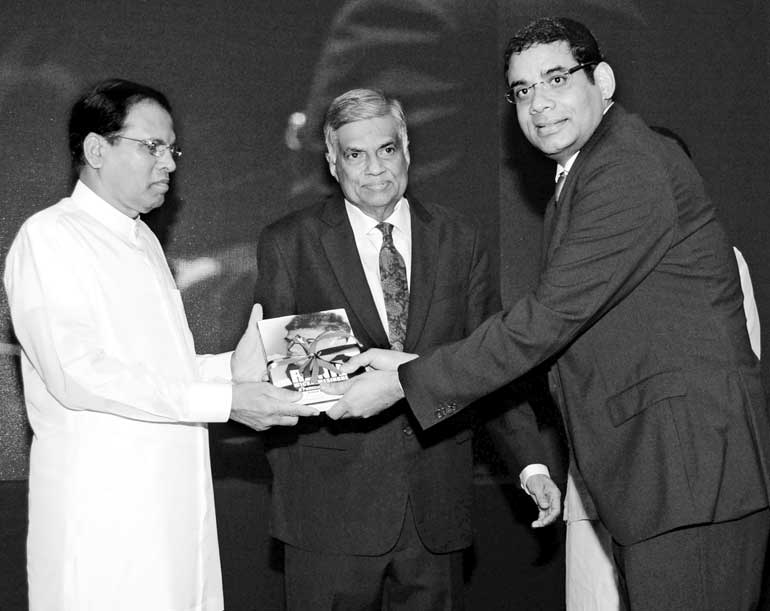
Dinesh Weerakkody recently launched a biography of Prime Minister Ranil Wickremesinghe among a distinguished gathering. The keynote speech was delivered by Sashi Tharoor, Indian politician and former Under Secretary General of United Nations.

He is the current Chairman of the Parliamentary Standing Committee on External Affairs. Minister Rajitha Senarathne delivered a speech and mentioned the leftist background of the PM’s father. He said that Wickremesinghe kept his multi-ethnic and multi-religious Royal College heritage right along so that he is more equipped to give a lasting solution to the ethnic problem of the country.

The book is a political biography of a leader who has been engaged in politics for 40 years so that the book eventually deals with the 40 years of political history of the country. After briefly describing Wickremesinghe’s political history in one chapter, the author describes the PM’s involvement in various important areas of Sri Lankan political history. This was an interesting approach against narrating the events in a chronological order.

Another praiseworthy aspect was that the author being a close associate of the PM was never hesitant to criticise the main character of his book where necessary. Therefore the book was never a mere admiration. 


Turbulent career 

Out of the Sri Lankan leaders Ranil has gone through the most turbulent career in politics. Greatness was thrust upon some of them and the others had to wait for a longer time till they got the baton. During his long and uninterrupted spell in Parliament Ranil had his ups and downs. As Weerakkody pointed out, he was given additional and responsible portfolios by President Jayewardene due to his ability and capacity to work. 01143

President Premadasa appointed D.B. Wijethunga as Prime Minister and Ranil Wickremesinghe as Leader of the house ahead of Lalith Athulathmudali and Gamini Dissanayake, his leadership contestants. After Wijethunga he lost the leadership to Gamini Dissanayake. Following the assassination of Dissanayake he became the Leader of the party and the Opposition. He became the Prime Minister for a short spell where the President was from the Opposition party. He lost presidential elections twice, once after the assassination attempt by LTTE on the incumbent President and then after the LTTE ordered Tamils not to vote at the election. 

He faced several challenges to his party leadership and however managed to survive. He had to hand over the Opposition nominations to two common candidates, one lost and the other won. In Ranil’s words, “The important thing is never give up and standby what you believe in, JR did that and Premadasa followed.” Page 148

Ethnic conflict

“In 2002, with no end in sight to the ferocious war that was raging, Prime Minister Ranil Wickremesinghe signed the Ceasefire Agreement that brought the war to an end. The signing of that agreement was the act of a statesman who put country before self and the Right to Life above all others… When he said that he would negotiate a ceasefire and an interim administration with the LTTE, he stuck to this platform although defeat after defeat followed him.” Page 150

“It is seldom that ethnic and religious minorities can determine governments. But despite losing ethnic majority support, and losing elections as a result, Ranil Wickremesinghe stayed steady to his course.” Page 148

This was an attribute of a selfless leader. A not-so-close parallel would be Mahatma Gandhi. Gandhi conducted his last hunger strike on two demands that Indian Government should pay 350 million to the Pakistan Government and the Hindu refugees who came from Pakistan should release the properties they forcibly acquired from Indian Muslims. The Indian people and Prime Minister Jawaharlal Nehru conceded in three days. 

In this line the PM met his counterpart in the President who fought hard to reduce his own powers which is a rare phenomenon in world politics.


Inaction of PM

“It may therefore be better if Ranil puts his resources to full use now in fighting corruption and taking the country on the development road. This is what the public and Maithri (the President) want from him.” Page 116

In Annexure 1, Weerakkody has given his own article published in Daily FT titled ‘Ranil must rise to the challenge and deliver before it’s too late,’ where he blames that so many people are slowly getting disillusioned with Ranil’s style of governance. 

This is the common consciousness of majority of the people who are used to being under near dictators. There are two issues at hand, one is political reforms and the other is economic reforms. Under political reforms we need to have a new constitution and a mechanism of power sharing. 

Previous governments tried both these without the support of the Opposition or the Opposition deliberately did not support since they have put their own objectives ahead of the national objectives. However ours is a democracy and not a government like that of Lee Kuan Yew. Therefore we need the consensus of all the intellects, idiots and foxes. Presently we are passing that lull period. 

When Gandhi stared the hunger strike, the people understood the justice in three days. Our people need much more time. The Sub Committee of Centre-Periphery Relationships of the Steering Committee of the Constitutional Assembly published its report where Chief Ministers of the Sri Lanka Freedom Party recommended that the powers of the Governors should be curtailed drastically which needs a referendum although the SLFP officially rejected a referendum. 

Several members of the Joint Opposition actively participated this sub committees. The debate is going on. Ranil does not want to take this to the people and get ownership of it but he facilitates the exercise. This is everybody’s baby. If no one is wearing that hat, civil society should do so. The country needs all the corrupt and un-corrupt politicians in this process so that the Government is not in a position to pursue anti-corruption campaign at this moment. That is the crux of it.

On the economic front successive governments maintained deficit budgets for popular reasons. Deficits were supported by loans. In the past we got grants since we were a low income country. Now the situation is different and we get commercial loans instead of grants. As a result of deficit budgeting, interest rates and inflation rates have gone up with the arbitrary holding of the exchange rate by the successive governments. Hence governments facilitated an anti-export policy, resulting in balance of payment issues. 

The previous Government took massive loans and invested in uneconomical projects at least in the short run. Government revenue and export earnings have dropped drastically. Now we are stuck and cannot invest in development projects. 

Opening of the economy in 1977 was the first economic revolution. At that time as a country we were stuck. There was a lot of opposition to the open economy and some of the businesses which were under State protection went out of the scene. Successive SLFP governments also followed the same policies. 

Now we want the second economic revolution. That is Free Trade Agreements. Ranil plans to extend the existing one with India, to have new agreements with China and with Singapore. “Ranil launched a plan to reform State-Owned Enterprises, enter into trade agreements with India and China, to increase market access and restructure the key investment promotion agency to become even more appealing to foreign investors.” Page 183

As happened in 1977 some of the businesses will have to be closed. Our businessmen should take up the challenge to take on the markets of those big countries. Or else foreign investors should come to take those opportunities. The majority of the country including the businessmen and professionals are in the defensive mode. They may be thinking that it is wiser to safeguard present pennies rather than going for future pounds.

Politicians like to keep loss-making government institutions, to exercise their power and to appoint their henchmen to vacancies (or otherwise) in reciprocal favours. They make propaganda that selling those institutes is a loss to the country. In fact, the loss is to maintain those institutes with taxpayers’ money. People do not understand this and vote against selling those assets affiliated with a false sense of nationalism. So the hard pills have to be taken just for survival. It might take some time to get the mindsets changed since we are a democracy.

I suppose those are the reasons of visible inaction of the PM who was very active in 2001.


Social market economy

Social market economy combines free market economic policies and characteristics of a welfare state. This was initially introduced in Germany in 1949 by Chancellor Konrad Adenauer.

“Ironically Ranil addressing a World Bank sponsored summit which was held in the Colombo suburbs (early 2016) said that his Government wants to consciously reduce indirect taxation. The Premier said that currently 80% of tax revenue comprised indirect taxes, while only 20% came from direct taxes. He said that this was wrong, considering the fact that 80% of the country’s wealth was held by 20% of the population. Ranil further said that we want to reduce indirect taxation to 60%, while at the same time enhancing direct taxed to 40%, comparable to global standards.” Page 128

Figures of India or Singapore are very much closer to the standard the PM mentioned. The PM’s vision appears to be that to take the country from crony capitalism sponsored by successive governments to social market economy.


Personal attributes

“His tendency to gather around him his close friends of years gone by, who have done very little to help him when he was in the political wilderness, but flock around him when he is in power, has been one of his outstanding weaknesses, which has drawn justified criticism from many quarters.” Page 181

In the Preface Weerakkody said: “Ranil is surprisingly a very simple man who never throws his weight around. He is only interested in getting a job done well.” 

“His seeming reluctance to mix freely with friends, and more so with the common man, made it difficult even for those who admired him, and wanted to enthusiastically support him. This flowed more than an innate shyness than from a seemingly feeling of superiority, but the result was the same.” Page 180

Recently when the Meethotamulla garbage dump collapsed, the PM was in Japan. He cut short his next visit to Vietnam and rushed back. Thereafter he has visited the site although several other members of the Government did not visit the place and those who were visited were booted out by the people. However he was with a facemask when all the people accompanied him were without facemasks. This is Ranil and I think the people of this country should learn how to live with this character for the benefit of them, their children and their country.
Published in DailyFT on 6th May 2017)

Corporate ethics and Hayleys legacy

In the USA the term corporate ethics came into use in the 1970s. The Enron Corporation scandal in 2001, which was considered as the biggest audit failure as well, has given much emphasis to corporate ethics in addition to various other measures. 

In Sri Lanka, the Institute of Chartered Accountants published the Code of Best Practice on matters related to financial aspect of corporate governance in December 1997. The latest edition, Code of Best Practice on Corporate Governance, was issued jointly with the Securities and Exchange Commission in 2013. This publication, under Code of Business Conduct and Ethics, cites 10 aspects including Conflict of Interest, Bribery and Corruption, and Entertainment and Gifts.

“A Conflict of Interest occurs when an individual’s private interest interferes (or even appears to interfere) in any way with the interests of the company as a whole. A conflict situation can arise when a Director or a Key Management Personnel performs or has such interest that may make it difficult to perform his company work objectively and effectively.”

Under Bribery and Corruption, it stated that the company or employees should not directly or indirectly offer, promise, solicit or accept any gift payment or other benefit as a reward or inducement of any improper conduct.

In Buddhism, Right Livelihood – Samma Ajiva – is one of the eightfold path to liberation. 

“To lay disciple the Buddha teaches that wealth should be gained in accordance with certain standards. One should acquire it only 01by legal means, not illegally; one should acquire it peacefully, without coercion or violence; one should acquire it honestly, not by trickery or deceit; and one should acquire it in ways which do not entail harm and suffering for others.” (Anguttara Nikaya)

“The Buddha mentions five specific kinds of livelihood which bring harm to others and are therefore to be avoided: 
  •  dealing in weapons, 
  •  dealing in living beings (including raising animals for slaughter as well as slave trade and prostitution),
  •  dealing in meat production and butchery, 
  •  dealing in poisons, and
  •  dealing in intoxicants (Anguttara Nikaya 5:177).”
“He further names several dishonest means of gaining wealth which fall under wrong livelihood: practising deceit, treachery, soothsaying, trickery, and usury (Majjima Nikaya 117). Obviously any occupation that requires violation of right speech and right action is a wrong form of livelihood, but other occupations, such as selling weapons or intoxicants, may not violate those factors and yet be wrong because of their consequences for others.” (www.vipassana.com)

How Hayleys began

Origin of Hayleys was in 1878 in Galle, which was then the main port of the country. Hayleys was the first company in Sri Lanka where there was a management buyout. 

In 1952 George G. Hayley with senior executives also subscribing to equity formed Hayleys Ltd. with a paid up share capital of Rs. 200,000 to acquire from the heirs of the late Chas P. Hayley and W.W. Kenny the entire undertaking of Hayley & Kenny. (www.hayleys.com)

Legendary Chairman of Hayleys D.S. Jayasundara was appointed to the Board in 1964 and he took over as Chairman in 1977. Prior to that the Chairman of Hayleys was George Bobbiese, who promoted exports with a vision. 

Jayasundara once said Hayleys lost its import businesses overnight due to the restrictions imposed by the Sirima Bandaranaike Government (1970-1977). In the subsequent budget speech of Dr. N.M. Perera, the word export was mentioned so many times (he mentioned the exact number of times) and the Board decided to promote export businesses in which they were already engaged in the form of exporting of coir fibre and related products.

The pioneering export companies, Haycarb (1973) and Dipped Products (1976) came into operation under the leadership of Bobbiese. These two export companies, led from the beginning by Rajan Yatawara and N.G. Wickremeratne respectively (both of them became Chairmen of Hayleys subsequently), were grown extending the manufacturing facilities to overseas as well and gaining global leadership in the respective manufacturing sectors they were in. 

In the agricultural sector Hayleys was able to link the rural farmers in Sri Lanka to global companies like McDonalds, raising their living standards and at the same time introducing them to the banking system of the country. 

Sri Lanka today has lost the focus on exports and the export earnings of the country has dropped from 40% of GDP to 20% of GDP over a period of two decades. When the top 25 companies of Sri Lanka are considered, about 50% of those companies are in the banking and financial industry, which is not a healthy sign. Only Hayleys and another company are engaged in exports. 

If the country, the Government and the business community are concerned about exports and the industry is properly incentivised, the balance of payment problem faced by the country would have been eased to a great extent. 

Hayleys accounts for over 3% of export earnings of the country. 

Right livelihood

During the time of Jayasundara, Hayleys was grown tremendously. He also appeared to apply the Buddhist principles of right livelihood. Hayleys was never engaged in any business where slaughtering of animals was involved. In fact, offers to take over such companies were turned down. Dealing in weapons or selling intoxicants were not among the businesses of Hayleys. 

Moreover when there was an offer to take over a hospital, it was turned down. There was a question of why hospitals. The answer was this. When a person is sick, guardians are prepared to pay any amount to save the life of the patient. As a business entity, the company should focus on profits. It was the view that it was not appropriate to make profit out of a person who was so desperate. It was perfect adaptation of Buddha’s saying as given above, “and one should acquire it in ways which do not entail harm and suffering for others”.

In Sri Lankan culture, traditional physicians even today do not charge from the patients and rather patients are allowed to pay whatever the amount based on what they can afford.

Jayasundara was invited to the boards of various companies and he encouraged his assistants of taking directorships of various corporates. Mahendra Amarasuriya who was a Board member at that time and who became the Deputy Chairman after the demise of Jayasundara in 1993, was once offered the directorship of Distilleries and he refused because it was Distilleries. Similarly Sunil Mendis who became the Chairman after Jayasundara was offered the directorship of Ceylon Tobacco and he refused because it was tobacco. They did not have any disrespect for those companies but those were their personal views probably shaped by Buddhist culture. 

Mendis had a policy that since he was paid by Hayleys he should not give his time to private sector companies where there was a payment as director’s fee. However he was a director of Bank of Ceylon for about a decade during which period Hayleys Group did not have any major facility with Bank of Ceylon.

Hayleys did not give any bribes in getting its jobs done. In the case of certain approvals of import and export activities when there were questionable transactions, particular operations were outsourced so that the company would not get involved in such activities.

When employee share ownership trust was created during the time of Sunil Mendis, the main Board members who worked in executive capacities did not take any benefits whereas the norm was that the top employees would get more benefits in such schemes. The gratuity system of Hayleys, once again introduced at the time of Sunil Mendis, gave more benefits to the employees who had long services which went very much beyond the requirements of the Gratuities Act. 

Maximising profit is not everything. This legacy contributed to Hayleys getting the Best Corporate Citizen award five times and the Grand Slam award. 

I met Sunil Mendis recently at a wedding and told him that I would write an article about Hayleys. He told me that it was good and to write about other companies as well which helped the economy of Sri Lanka. He also wanted me to not highlight his name and those of his colleagues. That shows the simplicity of the man and of the Hayleys culture.
(Published in DailyFt on 17th April 2017)

Right to information: A tool to empower people

Recently I had an opportunity to discuss the Right to Information Act with Will Ferroggiaro, a Washington DC-based consultant with more than 20 years’ experience working on freedom of expression, Government accountability and human rights. 

He has worked on the right to information in countries around the world, including India, Japan and South Africa as well as the US. Previously, he directed the media and conflict project for Internews and led the freedom of information project for US NGO National Security Archive, where he negotiated policy with the White House and authored reports on implementation of right to information laws. He was also twice elected President of the American Society of Access Professionals.

The US equivalent of the Freedom of Information Act (FOIA) was passed in 1966 when Lyndon B. Johnson was the President. Over 50 years the Act was amended seven times, including last year. Initially the US Government allocated $ 10,000 for the entire program in the first year. 

Later it was realised that it was grossly inadequate and proper research, leadership and incentivisation or training was needed for successful implementation. The US Act was implemented after one year and Sri Lanka being the 115th country to adopt the right to information law, implemented it within six months of passing the law, which is a very ambitious target.  

Ferroggiaro pointed out that the business community could use the provisions of RTI laws to access information about potential procurements, obtain data from competitors’ submissions to authorities or even learn about meetings between business rivals and the Government, thereby serving to counter corruption.

In response to a question over whether the cost of maintaining the whole mechanism of providing information to the people was worth it in relation to the current financial position of the Government and to the priority of the work that has to be attended, he said that this whole exercise could improve public trust in the Government. Citizens are given an opportunity to engage with the Government and through this process governments can acquire legitimacy. 

Proactive disclosure


Ferroggiaro praised the provisions in Section 8 on proactive disclosure where every Minister has to publish a report biannually before 0230 June and 31 December every year to enable citizens to exercise their rights to access information granted under the Act. The report should contain the particulars relating to the organisation, functions, activities and duties of the Ministry, and of the Minister and of all the public authorities falling within the functions so assigned together with several other items of information.

Responding to a question as to what extent the Right to Information Act would help ethnic and religious harmony in the country, he said in other cases the availability of data and facts informed public debate and helped counter the spread of false information which hampers ethnic and religious harmony. As an example of where documents released showed the complexity of a topic, he referred to the relations the US had with China and the 1989 Tiananmen Square protests. 

While documents released under FOIA detailed the killing of students and others, other documents showed that the US at the same time was concerned about China’s input on North Korea and trade so the US relations could not be focused on one issue as horrible as the massacres were. When I noted that the same complexity exists with the ethnic and religious disharmony in Sri Lanka, he said the Right to Information Act might ease the situation by injecting public debate with data and facts. If there are allegations that the Government policy benefits one community, data will bring clarity since data can either prove or disprove. As President Reagan once said: “Trust, but verify.” Therefore the right to information is a tool which can be used in many ways.

I asked him about the revelations of WikiLeaks and of Edward Snowden. He said those were unauthorised disclosures but those revelations showed the weakness of the system. It seems to be that a lot of secrets were kept. The US after the Cold War never revisited the logic of its National Security Information. President Clinton and President Obama took steps to declassify certain information. If the information is classified, the necessary authority should be obtained to reveal such information and if it is declassified such authority is not needed.

Ferroggiaro noted that with the pressure of civil society and members of Congress, US administrations from Clinton to Obama have released diplomatic military and intelligence files to support truth and reconciliation processes in Latin American countries in order to help them address the past and increase their stability and governance. Continued on page 25

Continued from page 17

Secretary of State Colin Powell, referring to a coup against President Salvador Allende in Chile in 1973, once said: “It is not a part of our history we are proud of.” This statement was made after the US had disclosed thousands of documents that showed US knowledge and involvement with the Chilean dictatorship, including its killing of Americans.

CIA revelations

Prior to the Iraq war in 2003, the CIA claimed that Iraq had weapons of mass destruction. Many in the US even then said that there were no weapons of mass destruction in Iraq. However, the war was launched in large part based on the CIA’s claim, which it did not publicly detail in full. In the end there were no weapons of mass destruction and the CIA lost credibility.  

Subsequently, when the CIA claimed North Korea had nuclear weapons, which happened to be true, people had reservations in believing the CIA. Therefore if more information is disclosed, it would contribute fruitfully to the public debate. The result is greater public trust and informed public input in policy.

I told him that Sri Lanka was not a rules-based country. We have the 13th Amendment to the Constitution where land and police powers are vested with the provinces. However, we still argue over whether to give those to the provinces or not. Also there was the Declaration of Assets and Liabilities Law passed in 1975.  We hardly use that. I asked him whether the Right to Information Act would also suffer the same fate.

He said he saw this as a political issue and not a cultural issue. For instance Donald Trump did not declare his assets before the election since it was not a law. Rather, it was a custom followed by all presidential candidates. Now there is an effort in Congress for it to become a law. He cited another example from the US where the CIA unlawfully destroyed videos of interrogations of certain terrorism detainees. Yet the FOIA law has been used by civil liberties groups to obtain information on similar detentions and to ensure due process even for those accused of terrorism.

The right to information will provide data as to why someone is not performing as required, adhering to law or favouring a constituent or business. Sri Lankans can make this country a rules-based country by using the right to information as a tool which can create an accountability culture here.

I asked him whether it would take several years for us to reap the benefits of the right to information. He said that the benefit was immediate. You have the right to exercise it. Information is power and those who hold information have power. The Government holds it temporarily to run the country on the public’s behalf. Since the people have sovereignty, ultimately the information should belong to them. Therefore there will be a shift of power. People have given the power to the Government on trust. People should be aware of their rights and exercise those rights. The right to information is a tool to enhance an accountability culture.

Sri Lanka has learnt the best practices of the world and incorporated them into the Right to Information Act. Sri Lanka in turn can share its experiences with the world.
(Published in DailyFT on 17th March 2017)

The President and his backbone


Untitled-1

The President told the SLFP Executive Committee meeting that he has shown his ‘backbone’ to the international community by rejecting the UNHRC Chief Zeid bin Ra-ad Al Hussein’s recommendation for a hybrid court to probe war crimes allegations in Sri Lanka. 

“Two weeks ago the UN Human Rights High Commissioner in his report on Sri Lanka called for a probe by foreign judges. Within 24 hours, I rejected it saying I am not prepared to bring foreign judges here,” he said. “There can be people without a backbone. But I am not ready to go forward with those without a backbone.” (Daily Mirror, 4 March)437

The High Commissioner’s report to the 34th session of the Human Rights Council includes the following comments as well:

“The fulfilment of transitional justice commitments has, however, been worryingly slow, and the structures set up and measures taken during the period under review were inadequate to ensure real progress. 

“Party politics, including the balancing of power between the different constituencies of the coalition in the run-up to constitutional reforms, have contributed to a reluctance to address difficult issues regarding accountability or to clearly articulate a unified position by all parts of government. Unclear and often contradictory messages have been delivered on transitional justice mechanisms by the President, the Prime Minister and various members of the Cabinet. Similar contradictions are visible in policy development. This tension was apparent both in the draft counter-terrorism legislation and on the proposed amendment to the Criminal Procedure Code. Public messaging around transitional justice and reconciliation has been generally confusing and at times contradictory.”


Devolution of power

The main task the country has in its hand is adaptation of a new constitution to address the grievances of the ethnic minorities and introducing a new governance structure. We know that the steering committee of the constitutional assembly cannot give a draft constitution although it received the reports of all six sub committees, due to the reason of the stance taken by the SLFP. 

The argument put forward by the SLFP is that they are no willing to go for a referendum. The two issues we have is devolution of power and abolishing of executive presidency. There were two key judgements given in relation to these two issues, judgement on the 13th Amendment to the Constitution and the judgement on the 19th Amendment to the Constitution. 

In the case of the 13th Amendment to the Constitution, there were nine judges to the bench and four judges were in favour and four judges were against. Justice Parinda Ranasinghe delivered an independent judgement which was in favour of the amendment with certain reservations. Therefore his judgement prevailed. 

If we were to go an inch beyond the provisions of the 13th Amendment it is obvious that there should be a referendum. By refusing a referendum, are we saying that we will not devolve power anything more than the provisions of the 13th Amendment?

The irony is this. The Chief Ministers of the Provinces governed by the SLFP proposed to the Sub-Committee on Centre-Periphery Relations appointed by the Steering Committee of the Constitutional Assembly that the powers of the Governors of the Provinces should be reduced drastically. The Chief Minister of North Central Province recommended that the post of the Governor should be abolished and the President should appoint the Chief Minister. The reason for this recommendation is this.

Article 154 C of the constitution states as follows: “Executive power extending to the matters with respect to which a Provincial Council has power to make statutes shall be exercised by the Governor of the Province for which that Provincial Council is established, either directly or through Ministers of the Board of Ministers, or through officers subordinate to him, in accordance with Article 154F.”

This overwhelming authority given to the Governor is questioned by none other than the Chief Ministers of the SLFP. Therefore we are talking of devolution of power to the provinces for the benefit of the provinces and as a by-product we devolve the power to the Northern Province where the majority are Tamils. 

The issue is we cannot devolve power further without getting the approval from the people at a referendum. President himself said that the country had to suffer this much due to the previous party politics of our leaders where Prime Ministers S.W.R.D. Bandaranaike and Dudley Senanayake had to abandon the power sharing proposals.

Therefore the President has to show his backbone to the party members of the party headed by him and tell them that as a country we have to take this opportunity to have an ethnic reconciliation. It is a prerequisite of economic development that we should have a solid ethnic reconciliation underneath. 


Abolishing of executive presidency

The President has pledged that the Executive Presidency will be abolished. During the period of 100 days the 19th Amendment was brought in and the powers of the President was curtailed amidst great reluctance and sabotage by the members of the party headed by him. Approach he has taken was commendable to curtail his own powers which brought international fame to him. 

However based on the judgement given on the 19th Amendment to the Constitution it was clear that if we need to curtail more the powers of the president or to abolish the executive presidency we have to go for a referendum. In fact the Supreme Court had rejected certain amendments of the draft 19th Amendment which gives more powers to the Prime Minister transferred from the President.

Therefore the President should show his backbone once again to his party members and tell them that it is mandatory to go for a referendum in order to fulfil the promises he has given to the general public.


Armed forces

If we take the examples of the Raviraj murder case, Prageeth Eknaligoda murder case and Lasantha Wickrematunge murder case, involvement of the members of the intelligence services is clear. It was evident in the Court that there was very little support to the proceedings from the Sri Lanka Army. We all know that it is not the intelligence officers who did the job who are responsible but the person/s who ordered to do the job should be responsible. The President should show his backbone to the Army and order them to give the full support to the Court proceedings.

It is true that the armed forces had done a great service in defeating an armed struggle against the democratically elected Government of Sri Lanka and we all should have a great respect for them. The value of the service is greater since it was believed then that the LTTE was undefeatable. However the credibility of the armed forces is internationally not up to the level of the job they did because of the allegations of violation of international law. 

The behaviour of some members of the armed forces were evidenced in the cases mentioned above. Hence in addition to ensure justice to the victims of the armed conflict, we all have a task of clearing the good name of our armed forces. One way of establishing that credibility is inviting foreign judges as members of the commission.

It was reported in Daily Mirror and Sunday Times on 4 March and 6 March respectively that the Prime Minister has mentioned that a referendum is needed to establish a Hybrid Court. There is no necessity to have a referendum to invite foreign judges to a mechanism established by Sri Lankan law. We have precedence in this respect since Sirima Bandaranaike Government invited foreign judges to a commission to probe the murder of Prime Minister Bandaranaike. However it looks like this is not feasible politically based on the political stance of the President. 

At the same time we have the right to expect the display of same solid backbone from the President in other issues discussed as well. It is pertinent to mention here that it is also the responsibility of the civil society to take the message of the new constitution and the devolution of power to the people at large in general and to the people who contributed to bring this Government to power in particular.
(Published in DailyFT on 7th March 2017)

GSP+, sovereignty and checks and balances

There is a debate whether the sovereignty of Sri Lanka is violated through GSP+ concessions to be given by the European Union 43(EU). GSP+ is a concession given by developed countries to developing countries on import duties. Therefore the imported goods from the countries which get GSP+ can be sold in those developed countries at a competitive price. As a result there could be more imports to those markets from those developing countries. 

The EU has granted this to several countries and in return they expect that those countries honourthe human rights conventions.In the Asian region Pakistan is getting GSP+ concession from the EU.Sri Lanka signed 27 international conventions on human rights, labour rights, good governance, sustainable development and environment protection. The following are those conventions:

1. International Covenant on Civil and Political Rights

2. International Covenant on Economic Social and Cultural Rights

3. International Convention on the Elimination of All Forms of Racial Discrimination

4. Convention on the Elimination of All Forms of Discrimination against Women

5. Convention against Torture and other Cruel, Inhuman or Degrading Treatment or Punishment

6. Convention on the Rights of the Child

7. Convention on the Prevention and Punishment of the Crime of Genocide

8. Minimum Age for Admission to Employment 

9. Prohibition and Immediate Action for the Elimination of the Worst Forms of Child Labour 

10. Abolition of Forced Labour Convention 

11. Forced Compulsory Labour Convention 

12. Equal Remuneration of Men and Women Workers for Work of Equal Value

Convention 

13. Discrimination in Respect of Employment and Occupation Convention 

14. Freedom of Association and Protection of the Right to Organise Convention 

15. Application of the Principles of the Right to Organise and to Bargain Collectively.

Convention 

16. International Convention on the Suppression and Punishment of the Crime of

Apartheid

17. Montreal Protocol on Substances that deplete the Ozone Layer

18. Basel Convention on the Control of Trans-boundary Movements of Hazardous Wastes

and Their Disposal

19. Stockholm Convention on persistent Organic Pollutants

20. Convention on International Trade in Endangered Species

21. Convention on Biological Diversity

22. Cartagena Protocol on Biosafety

23. Kyoto Protocol to the UN Framework Convention on Climate Change

24.  UN Single Convention on Narcotic Drugs (1961)

25. UN Convention on Psychotropic Substances (1971)

26. UN Convention against Illicit Traffic in Narcotic Drugs and Psychotropic Substances  (1988)

27. Mexico UN Convention against Corruption

By implementing these conventions, the Government is doing nothing but ensuring the sovereign rights of the people of Sri Lanka. 

EU has granted GSP+ to Sri Lanka in 2005 and requested that Sri Lanka should honour those conventions which were already agreed upon by the successive Sri Lankan Governments. EU has withdrawn this concession in 2010on the grounds that Sri Lanka has not honoured three conventions mainly. Those were International Covenant on Civil and Political Rights,Convention against Torture and other Cruel, Inhuman or Degrading Treatment or Punishment and Convention on the Rights of the Child.

Sovereignty

In the Oxford dictionary, sovereignty is defined as follows. “The authority of a state to govern itself or another state”.

Article 3 of the Constitution of Sri Lanka is as follows. “In the Republic of Sri Lanka sovereignty is in the People and is inalienable. Sovereignty includes the powers of government, fundamental rights and the franchise.”

Article 4 of the Constitution explains that there are five ways the people can enjoy sovereignty. legislative power of the people shall be exercised by Parliament; executive power of the people shall be exercised by the President; judicial power of the people shall be exercised by Parliament through courts; the fundamental rights which are by the Constitution declared and recognised shall be respected; and the franchise shall be exercisable at the election of the President/Members of Parliament/and at every Referendum.

Therefore sovereignty is with the people and the Government is the trustee of the sovereignty. When EU tells the Government that it should follow the conventions it has already agreed to follow to give GSP+ concessions the sovereignty exercised by the trustee is affected. But by following those conventions it is ensured that the sovereignty of the people is safeguarded and established.

Consecutive Governments of Sri Lanka, after getting the trusteeship of the sovereignty of the people from the people,have taken away that very sovereignty of them from them. Therefore by the act of the EU it tries to safeguard the sovereignty of Sri Lankan people from the Government which is the trustee of that very sovereignty. 

Sovereignty of the people is sovereignty of the State. By asking Sri Lankan Government to adhere to those 27 conventions, the EU safeguards the sovereignty of the State and that of the people. In the run pseudo sovereignty of the Government is affected.It is a pseudo sovereignty since in this very instance the Government is influenced not to violate the sovereignty of the people who have transferred that very sovereignty to the Government in a trusteeship which would amount to treason.

If the EU tells the Government that it should change its foreign policy to suit the requirements of the EU to give GSP+ concessions, then it is a violation of the sovereignty of the people and theState.

Checks and balances

There is another aspect of this scenario. In an organisation, there are internal controls. If a payment is made for goods received, firstly there should be a confirmation that the goods are received and secondly the payment should be authorised. Then only the payment can be effected. There is automatic control of the activities of each person. Similarly, in macro level governance there are checks and balances. 

The Oxford dictionary defines checks and balances as follows.“Counterbalancing influences by which an organisation or system is regulated, typically those ensuring that political power is not concentrated in the hands of individuals or groups.”

For example, introduction of the Constitutional Council by the 19thAmendment to the Constitution was a mechanism to control the power of the President who appointed key personnel to key institutions which was taken over by the Constitutional Council. Checks and balances are inherent in any constitution. Sri Lanka is not an advanced democracy and rules are not adhered to the very letter. Hence there are instances that the power is misused and not punished. 

The act of the EU to ask the Government to adhere to the conventions, which were signed by successive Governments,to grant GSP+ facility is a piece of checks and balances operating outside theconstitutionto safeguard the interests of the people.

Therefore if anybody argues that sovereignty of Sri Lanka is affected by the introduction of GSP+, it is a false and misleading argument. In fact it safeguards the sovereignty of Sri Lanka, which lies with its people. However, the whole argument is based on the fact that there are no self-declared slaves in Sri Lanka.
(The writer is not an Attorney-at-Law but a Chartered Accountant.)
(Published in Daily FT on 25th Jan 2017)

CTF report and the Raviraj case judgement


Untitled-3

The Report of the Consultation Task Force on Reconciliation Mechanisms was handed over to former President Chandrika Kumaratunga by Task Force Chairperson Manouri Muttetuwegama on 3 January. 

The Consultation Task Force (CTF) had Zonal Task Forces operating in all the districts, gathered views from the people and prepared a detailed report elaborating on the Office of Reparations; Truth, Justice, Reconciliation and Non-Recurrence Commission; Office of Missing Persons; Judicial Mechanism; Transitional Justice beyond the four Mechanisms; and Support for affected individuals and communities-Physiological considerations and security. Untitled-2

It was an elaboration of suffering of the victims in all communities, Sinhala Tamil and Muslim. Not only that, it elaborated the suffering of the soldiers and the ex-militants of the LTTE as well. We need to consider the psychological support needed by all, victims, ex-militants and the soldiers. The previous Government discontinued the psychological support given to the soldiers who were involved in the operations. 

In the report it was stated that the security forces and police warned that this process of reconciliation would be counterproductive, compromise national security, deepen wounds and open new ones as well as exacerbate inter-ethnic and religious division. All security forces personnel categorically rejected international involvement in the accountability mechanism in particular. (Executive Summary B3)

The CTF also received submissions, largely from the Sinhala community, rejecting any international involvement in what they viewed as a purely domestic process. (Executive summary C23)  

Leader of the Opposition R. Sampanthan addressing the gathering on 3 January said that there was no possibility of levelling charges against the forces who fought the war against the LTTE on the orders of the democratically-elected Government of Sri Lanka. However, if any officer or soldier has killed those who were arrested or raped women, then it was a war crime. The law should be implemented against such persons and it is not going against the forces who fought the war. (Samabima Supplement, Ravaya 8 January)

This is the truth and we should appreciate that it comes from the Leader of the Tamil National Alliance. This statement should be given wide publicity but the Government failed to do so. 

According to the report, the Army representatives stated their support for a truth-seeking process and if there is any evidence of criminal activity, for the prosecution of the guilty. Given that as far as they were concerned no criminal activity had been undertaken, they saw no need for amnesty either. (Executive Summary B4)

Therefore the thinking of the Opposition Leader and the Army seems to be somewhat in line. This examination is needed because there were wild accusations levelled against the Government forces. Due credit was not given to the forces internationally for defeating the LTTE which was considered undefeatable.   

CTF recommends a hybrid court with a majority of national judges as well as a sufficient number of international judges. (Executive Summary C24)

The Daily Mirror reported on 6 January as follows:
Quote

Justice Minister Wijeyadasa Rajapakshe today said he had no confidence in the Consultation Task Force on Reconciliation Mechanisms (CTF) appointed by the Prime Minister. He said the CTF, which recommended the inclusion of at least one international judge on every bench set up to hear allegations of war crimes and the violation of human rights that had taken place during the final stages of the armed conflict in Sri Lanka. The Minister said some of the members of the CTF Committee were representatives of Non-Governmental Organisations (NGO). “No one is complaining about the independence of the Judiciary anymore. We have reconciliation and peace processes in place. This report, at this juncture, is totally unwarranted. Therefore, we don’t have to follow these recommendations by the CTF,” he told the Daily Mirror. 
Unquote

As former President Kumaratunga stated, he was there at the Cabinet meeting where the forming of CTF was discussed. He also tried to bring down the NGO phobia of the Rajapaksa regime. He has thrown away the entire report just because of the recommendation of the international judges. Independence of the Judiciary can be restored by refraining from giving calls to the Judiciary from President’s House or from Temple Trees but the restoration of the impartiality of the Judiciary is not that easy. No one complains about the independence of the Judiciary but there are questions of impartiality of the same. 

On 25 December 2016 the Daily Mirror reported as follows:

Quote

Jaffna District TNA Parliamentarian M.A. Sumathiran said yesterday that his political party was not satisfied with the verdict in the former Parliamentarian Nadaraja Raviraj’s assassination case and would file an appeal against the verdict.

“The judgment is indicative of the people’s distrust in the country’s Judiciary. It is in this scenario that we demand an international panel of judges to probe the alleged war crimes. As the lawyer who watched the interests of the aggrieved party, I will file an appeal,” he said.

Unquote

On 26 December 2016, The Hindu reported as follows:

Quote

“So it was obvious that a few junior-level naval officers had not done this on their own. They are as responsible for carrying out someone’s orders, but it is only one small part of the puzzle. This happened 10 years ago and we are still waiting to find out who gave the orders,” Sumanthiran told The Hindu on Sunday.

Unquote

On 12 January the Daily Mirror reported:

Quote

The Attorney General has appealed to the Colombo High Court against its judgement in the former TNA Jaffna District Parliamentarian Raviraj murder case and for a re-opening of the case for a retrial. The AG by the revision application filed in High Court had stated that on the day the decision of the Judge was pronounced in the case, the court has functioned further than the usual functioning time till midnight. The AG also had stated in the revision application that the presiding judge had not made any explanations on certain vital issues revealed in the trial. 

Unquote

The jury comprised all Sinhalese people. Here the three Navy Intelligence officers also were accused.  Not only in this case but also the cases of Prageeth Eknaligoda and Lasantha Wickrematunge where intelligence officers were accused, there were long delays of the judicial process. Once the President has openly accused the prosecution officers.

Therefore we do not have any moral ground to defend the position that there should not be any foreign judges in the investigation of so-called war crimes. Justice should not only to be done but also be seen to be done.
(Published in Daily FT on 17th Jan 2017)