Friday, February 21, 2025

What A Budget

 By Harsha Gunasena –

Harsha Gunasena

Prior to the Presidential Election I was at a seminar and I was questioned about what will happen after the elections. I said if Anura Kumara Dissanayake (AKD) wins he will continue with the IMF programme irrespective of the claims that NPP will seek to alter the Debt Sustainability Analysis (DSA). However, I said their problem would be the failure of implementing the capitalist economic reforms such as shrinking of the state sector and as a result the government would face difficulties in continuing with the IMF progamme.

When the President delivered his “throne speech“ at the Parliament, I said at a webinar (Kathikava) organized to discuss it by the National Movement for Social Justice, that AKD is more towards right compared to the other JVP leaders who are towards the left. Therefore, I liked keeping the Finance portfolio with him, although as a policy I disagreed to it since by that act financial control of the Republic by the Parliament, which is the legitimate right of the Parliament, is loosened. However, it was the best option under the given circumstances.

I expressed concerns that since the JVP is in power and not the NPP, their pro left ideology would hamper the essential economic reforms since capitalist reforms could not be done with a leftist ideology. I said however it would be possible if AKD would be able to take the control into his hands and that happened in the  budget speech.

In Sri Lanka people are worried when the government sells state assets. These people think that ‘somehow’ the state should manage it. There were instances where the state assets were sold to the cronies of the ruling party to which no one would agree. Even though the selling process is transparent these people disagree with it. In personal capacity they may sell their assets if faced by strong financial constrains, but not at the national level.

I presume that the former President Ranil Wickremesinghe (RW) delayed any privatization or restructuring the state assets or entities fearing of this public opinion orchestrated by mainly the people with JVP ideology. What is happening now is overruling the JVP ideology by the JVP which is beneficial to the country. In the coming years leftist ideologies will be crucified by the JVP and if not, the country will get crucified.

By this leftist ideology I mean mainly maintaining a large state. The JVP started talking of inequality of income distribution recently. In the policy statement of Rapid Response released during Covid time, they were focusing on criticizing the open economy in toto. It went on to state, “Introduced in 1977, the Open Economic Policy has been destructive through its prioritization of personal gain over social responsibility.” RW, considered as a neo-liberal, strengthened the monitoring power of the state by introducing various Acts which was contrary to the neo-liberal thinking.

In the budget speech AKD said that Sri Lanka’s network of Free Trade Agreements (FTAs) with strategic partners, particularly with a view to greater economic ties with ASEAN nations will be expanded through the Regional Comprehensive Economic Partnership (RCEP) and other agreements. There is no mention of reviewing the existing FTAs as mentioned in their election manifesto. The said group of Sri Lankan ideologists are against the FTAs.

AKD identified that the state is larger than it should be. Therefore, a Committee under the Prime Minister’s Secretary has already been appointed to review the functions and utility of a plethora of Government agencies. It would be possible to determine which agencies need to continue, which need to be amalgamated with other agencies, and which agencies need to be discontinued, which need to change their objectives. A Holding Company under the full control of the Government will be established under which selected SOEs are held as subsidiaries with a view to improve governance, financial discipline and operational efficiency. The government will actively encourage private and appropriate state entities to raise funds through listed equity and debt capital markets. Therefore, it is ideal if this Holding Company can be listed in the Stock Market even though it is under the full control of the Government.

The Government will lease out under-utilized state-owned land for productive economic activities. Some of the lands presently managed by LRC, RPCs, SLSPC, JEDB and under-utilized will be identified and brought in for private investment including SMEs taking the suitability of the land into consideration. The Government  propose to allocate Rs. 250 million to undertake initial activities in this regard. The proposed Colombo West Terminal 2 and Colombo North Port are expected to expedite the performance of Sri Lanka’s ports. Therefore, the Government will call for Expression of Interest for these projects within a month. These are not selling but ‘selling’ which is the real need of the country.

Government will call for foreign direct investments to optimize the utilization of Sri Lanka’s untapped potential in investment, industrial development, and value added exports of Sri Lanka’s mineral resources and marine economy. To provide energy at a competitive cost to industries, exporters, and consumers, the Government  will welcome energy investments based on the lowest tariffs and we will not provide preferential treatment purely on the company or the country of origin. The criticism of taking the profits away is not valid now.

There was a proposal to expand the export-oriented investments  through Public Private Partnership (PPPs) and privately run zones. The concept of privately run zones is a novel idea. There will be 5 industrial parks for which Rs. 500 million was allocated. it is proposed to establish an Industrial Estate dedicated for Automobile components and rubber manufacturing and Rs.1.5 billion was allocated for this. It is not sure whether this money is sufficient since over the several years there were proposals to have industrial zones but those were not implemented.

An Investment Protection Bill will be enacted to facilitate and protect investments, and a Public Private Partnership (PPP) Bill also will be introduced. He said that the country’s ease of doing business will be prioritized which is much needed.

Barriers for local firms to invest overseas will be reviewed and gradually rationalised by establishing appropriate safeguards to track repatriation of earnings and dividends. This is easing of the Capital Account. Commercial usability of land will be increased by expediting Bimsaviya but he was silent about the Urumaya pragramme the intention of which was also the same.

In order to support the SMEs, the Government is working towards setting up a development bank. As a first step, the function of a development bank through a new administrative structure will be established through the existing state bank mechanism. The Government will support this task through the National Credit Guarantee Institution (NCGI). Also Rs. 1000 million is allocated to commercialize the inventions.

The Government allocated Rs.35 billion for the fertilizer subsidy of paddy farmers and Rs. 78 billion to the irrigation sector development. In order to improve the productivity of the paddy farmers the Government should focus on allowing paddy farmers to cultivate commercial products which is prohibited in Agrarian Development Act.

Allocation of Rs.5 billion to purchase of paddy and Rs.20 billion to Sri Lankan Airlines would be a waste. Rs. 20 billion will be used by Sri Lankan Airlines to pay interests and repay the loans which may facilitate the company to borrow again. The President said that the treasury would not allocate money for recurrent expenses of the Airline. This colossal waste of public money to this “strategic investment” should be stopped.

The Government should explain why the existing vacancies cannot be filled by the graduates who are already recruited as development officers and who are not engaged with productive work.

In the previous budgets the common phenomenon was to have several budget proposals but hardly they were implemented. With financial constraints those will be thrown away out of the window. The capital expenditure would be affected first. It is likely since the recurrent expenses were increased in the budget proposals. I do not take these proposals seriously until they are implemented. However, the positive policy direction of the Government which is a deviation from the policy stance of the JVP would be a reality.

Published in Colombo Telegraph on February 17, 2025

https://www.colombotelegraph.com/index.php/what-a-budget/#google_vignette


 7
 9

leelagemalli
Thank you for your comment.
What we tell AKD is not to fulfill his promises. (not all the promises) For instance what will happen if they start negotiating with the IMF in respect of DSA? I do not care about his catching the thieves rhetoric. They may have lied the people intentionally. It is the fault of the people of accepting it. I am not concerned of the past. I am concerned of the future economic recovery of the country. If JVP tries to destroy it, I will oppose.


 5
 4

nimal fernando
1. Please refer the below link to refer the analysis of poverty by the Department of Census and Statistics. Poverty has gone down in Sri Lanka over the years but it has gone up in 2022 due to economic conditions.
chrome-extension://efaidnbmnnnibpcajpcglclefindmkaj/https://www.statistics.gov.lk/Resource/en/Poverty/PovertyIndicators-2019.pdf
2. Singapore adopted a capitalist economic model which was based on profitability whether the entities were private owned or state owned. Sri Lanka adopted socialist economic model where in state entities the main focus was not profitability.
3. I am not a fan of Ranil or anybody. If anything is correct in my view I say it is correct. Hambantota harbour was leased to a Chinese Company since the Government found it difficult to service the debt. AKD is going to do the same with Government lands.


 4
 5

nimal fernando
“who out there, can do it better than AKD? Any suggestions?”
In Sri Lanka I believe the problem is the people not the leaders. Leaders will have to think of the next election. Therefore they think how to pacify the people. That was the reason for the continuing budget deficits in Sri Lanka which is the root cause of the economic collapse which was triggered by GR’s folly.
If you want me to name someone, as far as the economic recovery is concerned it is RW+. He did it in 2001 and also in 2022 although people do not want to give the credit to him.
+ means he should not be burned with elections. He has several other weaknesses.


  •  4
     4

    Lester
    IMF plan is good for the financial stabilization. They do not build countries. Foe that we should have a plan to improve the growth especially improving on exports. For that the governments cannot simply request the businessmen. Conducive environment should be created such as FTAs.

    •  18
       7

      Harsha,

      You are correct to state that the IMF does not build countries. It keeps them ensnared in debt, which is a form of slavery. There are very few success stories when it comes to the IMF. This is something the IMF itself admits. These countries would have succeeded without the IMF; the latter was merely a temporary bandage. Iceland escaped its debt through international arbitration and high taxation. South Korea succeeded because of the work ethic; people used to work 6 days a week. What the IMF does well is facilitate low-interest rate loans for global corporations to hijack the natural resources and other valuable assets of developing countries, which in turn return very little to the native inhabitants living there.

      •  4
         0

        Lester
        What IMF did in Sri Lanka is to force the country to cut the coat according to the cloth. Simple as that. The Government was borrowing beyond its capacity to pay. At one point to pay the interest also it was borrowing. Now the Government should cover all it expenses from its revenue. Moreover there should be an excess which should be equal to 2.3% of the GDP. Now the Governments cannot give goodies to the voters and solicit the votes. Simple as that. Accelerating growth is the job of the Government. Since the Govt does not have money they should get the support of Private Sector and FDI. Simple as that.

        •  2
           5

          ramona therese fernando
          Yes, I agree with you. No other way than the way of RW. Give the due credit even to the devil. “government control over all sectors” will be a disaster. That is old Marxist rhetoric. Robbing is wrong and non-robbing is great. Solely by non-robbing countries cannot be recovered. “guess it will be a one-time debt payment” nonsense. All the previous government said that.

          •  12
             4

            Harsha Gunasena……That’s because RW made sure he tied up the system so tightly, there’s no way to move.


Sunday, February 16, 2025

A Critique Of The Proceeds Of Crimes Bill

 By Harsha Gunasena –

Harsha Gunasena

In the page 112 of the Election Manifesto of the NPP, A Thriving Nation – A Beautiful Life, it was stated that  a Stolen Public Asset Recovery Agency will be established  to recover the stolen state assets. It was also stated that the Director General of the Bribery Commission will be facilitated with necessary authority to give effect to the International Convention on the Prevention of Corruption and Coordinating the Recovery of Stolen Assets.

Stolen asset recovery was a popular election rhetoric which has elevated to the extent of coming out of the financial restraints of the country using the proceeds of the recovery of stolen assets.

The Extended Fund Facility  greement (EFF)was initiated by the Government of Sri Lanka (GOSL) with the IMF in April 2022, and the agreement was reached  in March 2023. Under EFF it was agreed that to enact a comprehensive Asset Recovery Law and to harmonize it with the United Nations Convention Against Corruption. This should be done in consultation with the IMF staff and the target date was given as November 30, 2024.

Therefore, it is not merely an election promise of NPP but a commitment given by the GOSL to the IMF. In June 2022, Minister of Justice Wijeyadasa Rajapakshe PC appointed an eminent panel headed by Justice Ysantha Kodagoda PC to develop the Policy and Legal Framework and Draft Provisions of the Proposed Law on Proceeds of Crime, well ahead of the finalization of the EFF agreement. The Committee released the final report in April 2024. The Committee consulted foreign experts as well and was based on many legislations including the Proceeds of Crime Act 2002-UK. The Proceeds of Crimes Bill  was published in September 2024. Now the GOSL has decided to present it to Parliament. The Bill is in line with the bill drafted by the committee and in most places of the text the two documents were identical.

Designated Officers of CIABOC and Police

Contarary to the  intention of the NPP in its election manifesto, there will not be a stolen public asset recovery agency instead the functions would be divided between the Sri Lanka Police and the Commission to Investigate Allegations of Bribery or Corruption (CIABOC).

There should be a Proceeds of Crime Investigation Division( PCID) established at the Sri Lanka Police and the Director General of PCID should be the Police Designated Officer (DO) referred in this Act. (Sec. 45).

He should be appointed by the National Police Commission (NPC) for a period of three years out of the three recommendations by the IGP and should not be a person below the rank of a DIG. He may be removed by the NPC in consultation with the IGP on the grounds of acting in a manner defeating the objectives of this Act.(There are certain specific points) The IGP has no authority to give investigation – specific orders to PCID. However, IGP can give directions to PCID with regard to the performance of  duties, functions and exercise of powers under this Act. (Sec 46)

For the purpose of this Act there should be a Designated Officer(DO) at the CIABOC, and that officer should be the Director General of the CIABOC. (Sec.47) There are respective Deputy DOs and the supporting investigation officers in the two institutions.

The Police DO and the DO of the CIABOC shall regularly discuss and agree on the manner in which mutual cooperation may be extended between their respective institutions towards effectively achieving the objectives of this Act. (Sec.48) The line of command of the two institutions in relation to this Act is given in Diagram 1.


The DO of the CIABOC is under the full control of the CIABOC whereas the DO of the PCID is under the control of the NPC in respect of administrative directions only. Although the Act specifically says that the NPC/IGP cannot give investigation – specific orders to the Police DO the Act does not specify such restrictions to the CIABOC in relation to the DO of CIABOC.

According to the Act, investigation- specific decisions should be taken jointly by the two DOs so that they both can act independently in respect of those decisions. The responsibilities and authorities under the Act are with the two DOs and in respect of CIABOC that authority and responsibility come through the Commission  (Sec.43) whereas the NPC/IGP has no say about that. Although NPC can remove him if he acts in a manner defeating the objectives of the Act, this is an establishment of an independent power center within the Sri Lanka Police.

Sri Lanka Police is governed by the independent NPC of which the commissioners are appointed through the Constitutional Council as defined in the Constitution of Sri Lanka. Therefore, this may undermine the authority of the NPC and there is no unity of command in this structure.

However, the Bill is silent about how to proceed if there is a dispute between the two DOs.

When a Police Investigation Officer comes across  a subject covered by the Anti-Corruption Act he should inform that to the DO-CIABOC through Police DO. (Sec.51-4) When a CIABOC Investigation Officer comes across a subject under the purview of the Police, he should inform that to Police DO through the IGP. (Sec.51-5) This is against the protocol. He does not have to inform or go through the DO-CIABOC and can directly approach the IGP.

One other example where the deployment of Police Officers needed is elections. At the time of holding of elections,  the Police Officers deployed should be under the control of the Election Commission.

According to the constitution of Sri Lanka, upon the making of an Order for the holding of an election, the Election Commission (EC) shall notify the IGP of the facilities and the number of police officers required and the IGP shall make available to the EC the facilities and police officers specified in any notification. Every police officer made available to the EC  shall be responsible to and act under the direction and control of the EC during the period of an election. (Article 104C)

In the Anti-Corruption Act there are provisions that the CIABOC can appoint their own investigation officers rather than depending on the Police whereas in the repealed Act the Commission was not independent in this respect and had to depend on the Police for the investigation officers.

There are two models here, the one adopted by the EC where the temporarily deployed Police Officers report to the EC and the other adopted by the CIABOC where they have their own investigators. In respect of Proceeds of Crimes Bill, a third model is introduced which is discussed previously. This may be the ideal solution with the circumstances and the drafters of the Bill wanted to minimize the undue influences on the PCID but I have doubts whether this arrangement would work smoothly when there is no unity of command.  Sri Lankan organizational culture does not promote collaboration but authority and command. With the  comparatively slowness of the decision-making process of the Public Sector the implementation of the Act would face a lot of hinderances.

PCMA and VCRTF

Under the Act Proceeds of Crimes Management Authority (PCMA) a body corporate, will be established for the purpose of protecting, preserving and managing proceeds of crime.(Sec.96) The PCMA shall have Management and Administration Fund (MAF)  and a Fund for the Protection, Preservation and Management of Proceeds of Crime (PPMF). (Sec 112) In addition to that there will be a Victims of Crime Reparation Trust Fund (VCRTF) (Sec.131)

Recovery of stolen assets

With the introduction of the Proceeds of Crimes Act to recover stolen assets, we have all the required legal provisions which include the Anti- Corruption Act  with wide authority to the CIABOC to combat corruption.  However, the process is very long. The necessary steps are given in the Diagram 2. Therefore, if someone wants to have quick results, he will be disappointed.

Diagram -2

Stolen Assets Recovery Process
(source:  https://star.worldbank.org/focus-area/asset-recovery-process)

https://www.colombotelegraph.com/index.php/a-critique-of-the-proceeds-of-crimes-bill/

Published in Colombo Telegraph o February 3, 2025


Friday, January 17, 2025

This is not expansion of tax net but expansion of net of inefficiency


The President tries to cover up the inefficiency of IRD and ask a set of people to pay WHT in excess of their liability


On 18 December 2024 President Anura Kumara Dissanayake announced in Parliament a series of tax changes. Some taxes were increased while the other taxes were decreased. Those changes were revision of personal income tax, increase in withholding tax on interest from 5% to 10%, imposition of VAT of 18% on digital services, removal of export service exemption on income tax and tax them at 15%, increasing the corporate tax rates on betting, tobacco and liquor industries from 40% to 45%, grant exemptions to locally produced liquid milk and yogurt industries on VAT which is 18%, increase stamp duty on leases from 1% to 2%, continuing SVAT system contrary to the agreement with the IMF, and removal of vehicle import restrictions. 

Income tax

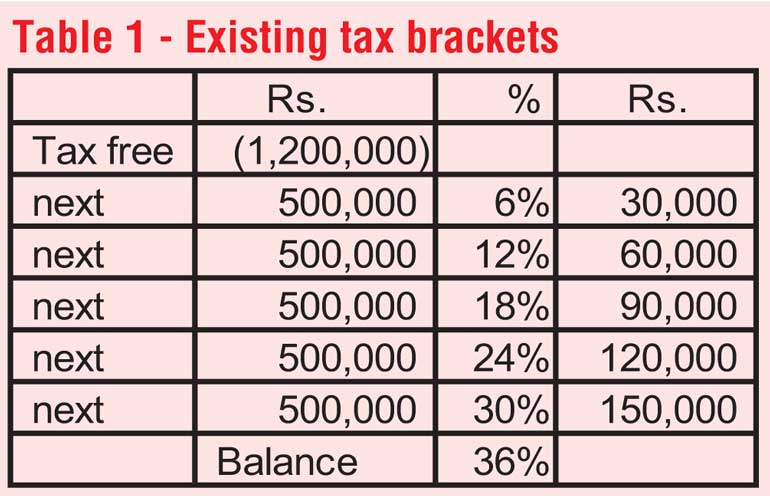
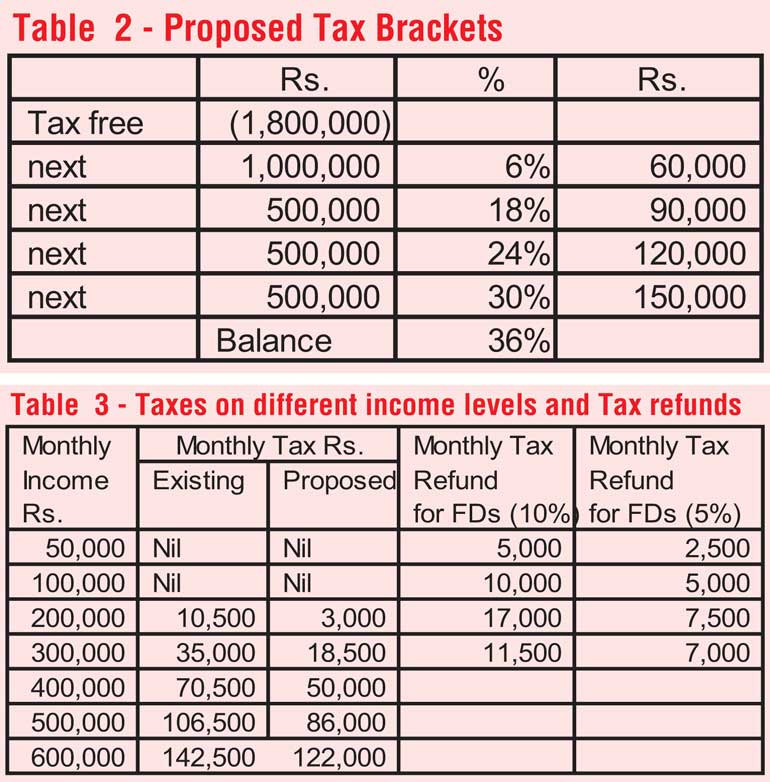
Accordingly the current minimum annual level of taxation Rs. 1.2 million will be increased to Rs. 1.8 million. Hence the minimum monthly level of taxation will be increased from Rs. 100,000 to Rs. 150,000. In addition to that the first tax bracket of Rs. 500,000 will be increased to Rs. one million. Taxes will get reduced due to that as well. The existing tax brackets are in Table 1 and the proposed tax brackets are in Table 2. In Table 3 it was indicated the tax implications of the current system and the proposed system for the levels of monthly income from Rs. 100,000 to Rs. 600,000. The last two columns are relevant to the With Holding Tax discussed later.

National People’s Power (NPP) promised in their election manifesto that the minimum monthly level of taxation will be increased to Rs. 200,000 but it would have been a greater revenue loss. The previous Government also approved a tax reduction by increasing the size of the tax brackets from Rs. 500,000 to Rs. 720,000. The President said that his proposal was approved by the IMF.

I do not think that there is value of IMF approving these different methods. The IMF has clearly indicated the targets to be achieved. In relation to these, achievable targets are government tax revenue as a percentage of GDP (in 2025 13.9%) and primary account balance which means the government total revenue minus government expenditure other than interest payments and debt repayments, as a percentage of GDP (in 2025 2.3%). If these targets are not achieved even though the IMF have “approved” the revenue proposals, they would consider this as not fulfilling the requirements of the agreement. The conditions of this agreement are beneficial to the country since those considerably reduce the possibility of getting bankrupt again. 

PAYE tax is not a final tax. It is a withholding tax. Although it is a withholding tax if the taxpayer does not have any other income or deductible expenditure it would be equal to the final tax. If there are deductible expenses the taxpayer can request the Inland Revenue Department (IRD) to give directions to the employers not to deduct PAYE tax or to deduct a lessor amount depending on the circumstances. 

Withholding Tax (WHT)

The President declared in the Parliament that the WHT on interest will be increased from 5% to 10%. Since this is a WHT and it is calculated on the interest earned, the final tax calculated based on the second Chart would differ from the WHT deducted. The interest rates are in the downward trend so that if the interest rate earned is 8%, to have the WHT and final tax be at the same level, the deposit amount should be Rs. 54.2 million. This means that if the deposit is less than that amount the WHT of those depositors would be more than the final tax. If the interest rate is 9% this limit would be Rs. 48.2 million. Since the interest rates are going down this limit will be increased further.

What does this mean? This means that the retirees and others who live on interest on fixed deposits should go to the IRD in order to claim the WHT in excess of their due tax.

In the one before the last column of Table-3 it is indicated that the amount to be refunded since the WHT is more than the final tax, at each income level if it is solely of the interest income. Accordingly at the monthly income levels of Rs. 50,000 and Rs. 100,000, which are not subject to income tax, the monthly amounts to be refunded would be Rs. 5,000 and Rs. 10,000 respectively. WHT of 10% would be more than the final tax up to the monthly level of Rs. 361,000. Those who earn more than that amount would have to pay additional taxes to IRD since WHT is less than the final tax. In the last column the same type of information is given when the WHT is 5% and the tax calculation is based on the new proposals.

The increase of the WHT is a harassment of many low-income earners. Even now it is happening. The President declared that there will be a dedicated unit established at the IRD to direct financial institutions not to deduct WHT or to deduct a lessor amount from those who affected.

If IRD can do this job effectively, why does the government need to request from the IMF, contrary to the agreement, to continue with the SVAT system? What is SVAT? According to the VAT system enterprises should add 18% to the goods and services sold. Also they have to pay 18% more to the goods and services they purchase. They have to pay IRD the balance after deducting VAT paid on goods and services purchased from the VAT collected on goods and services sold. Exporters are exempt from VAT at the point of export. Hence IRD will have to pay back the VAT they paid at the point of purchase. IRD did not handle this effectively and there were long delays with the paybacks.

As a result, IRD implemented a system that the suppliers to exporters do not charge VAT from the exporters. This system is called SVAT. 

How can we trust that a department which delays VAT refunds to exporters, would pay back the excessive WHT deducted from a large number of ordinary men and women? The Government wants to extend the SVAT system since they know that the IRD is inefficient.

The other point is that the declaration of the President that by increasing the WHT, the tax net is widened. It is not. By the very act of imposition of WHT irrespective of the rate, the tax net widens. There is no need to increase the rate since the financial institutions remit the WHT deducted to the IRD together with the NIC numbers of the respective depositors. With this information the IRD is in a position to calculate their incomes and ask them to pay the taxes accordingly. The President tries to cover up the inefficiency of IRD and ask a set of people to pay WHT in excess of their liability. How can we trust that the inefficient IRD will promptly pay back the additional taxes collected and give directions to the financial institutions not to deduct WHT from those who are not liable? Therefore, this is not expanding the tax net but expanding the net of inefficiency. Moreover, it discourages savings which is unfavourable to the economy. There are no economists, no tax consultants, no trade unions, no politicians and finally no so-called socialists to voice in favour of them.

The President mentioned in Parliament only about the WHT on interest. At present there is a WHT collected by the commercial entities at the rate of 5% from whom supply the professional services to them. The President did not mention about this category. It is not clear whether they are liable or not liable for the increase of the WHT. Also, there is a possibility that this WHT which was increased could be the final tax as well.

WHT is charged by the governments throughout the world. The main intentions are to avoid tax evasions and collect the taxes in advance. If the IRD is efficient as explained tax evasion can be avoided even with 5% WHT. The Government probably focused on the receipt of taxes in advance. Keeping the taxes collected by force from those who are not claiming it back is getting enriched unduly. 

Other taxes

I have seen some comments that the enterprises would not pass the benefit of the reduction of VAT of liquid milk and yogurt to the consumers. It is not possible since producers are marking the prices in the product.

It is a requirement to open the imports of vehicles and other products. The previous Government also announced that vehicle imports will be allowed in February. If the imports increase the rupee will be depreciated and would create a positive environment to the exporters and at the same time costs of imported goods will be increased and cost of living would increase. However, if vehicle imports are allowed with the intention of achieving revenue targets agreed with the IMF, then it would be risky. 

(Published in Colombo telegraph on January 10, 2024 and in Daily Ft on January 17, 2024)

https://www.colombotelegraph.com/index.php/this-is-not-an-expansion-of-the-tax-net-but-an-expansion-of-the-net-of-inefficiency/

https://www.ft.lk/columns/This-is-not-expansion-of-tax-net-but-expansion-of-net-of-inefficiency/4-771854


මෙය බදු දැළ පුළුල් කිරීමක් නොවේ; අකාර්යක්ෂමතා දැළ පුළුල් කිරීමකි

 හර්ෂ ගුණසේන –

හර්ෂ ගුණසේන

ජනාධිපති අනුර කුමාර දිසානායක මහතා විසින් පසුගියදා පාර්ලිමේන්තුවේදී බදු සහන සහ නව බදු  පිලිබඳ නිවේදනයක් කරන ලදී. මේ අනුව යම් බදු අඩුකරන ලද අතර තවත් බදු වැඩි කර ඇත. ඒවා  නම්  පුද්ගල ආදායම් බද්ද අඩු කිරීම, පොලිය මත දැනට ඇති රඳවා ගැනීමේ බද්ද 5% සිට 10% දක්වා වැඩි කිරීම, අනේවාසික ඩිජිටල් සේවා සපයන්නන් 18% වැට් බද්දට යටත් කිරීම, අපනයන සේවා සපයන්නන් 15% ක ආදායම් බද්දකට යටත් කිරීම (මේ තාක් ඔවුන් ආදායම් බද්දෙන් නිදහස් විය.) කැසිනෝ, දුම්කොළ සහ මත්පැන් ව්‍යාපාර සඳහා වන බද්ද 40% සිට 45% දක්වා වැඩි කිරීම, දේශීය දියර කිරි සහ යෝගට් නිෂ්පාදකයන් 18% වැට් බද්දෙන් නිදහස් කිරීම, කල්බදු ගිවිසුම් සඳහා වන මුද්දර ගාස්තුව 1% සිට 2% දක්වා වැඩි කිරීම, අපනයන ව්‍යාපාර වලට භාණ්ඩ සහ සේවා සපයන්නන්ට අදාල වන SVAT බදු ක්‍රමය එකඟ වූ IMF කොන්දේසි වලට එරෙහිව තවදුරටත් පවත්වාගෙන යාම සහ වාහන ආනයනය සඳහා වන තහංචි අනුක්‍රමයෙන් ඉවත් කිරීමයි.

ආදායම් බද්ද

ඒ අනුව දැනට පවතින ආදායම් බද්දට යටත් වන සීමාව වාර්ෂිකව රු. 1,200,000 සිට රු. 1,800,000 දක්වා ඉහල නංවන ලදී. ඒ අනුව මාසිකවබද්දට යටත්වන දැනට පවතින අවම ආදායම වන රු.100,000 මුදල රු.150,000 දක්වා වැඩිවේ. ඊට අමතරව රු. 500,000 පළමු කාණ්ඩය රු. මිලියනය දක්වා වැඩිවේ. ඒ නිසාද බද්ද අඩුවේ. මෙම පවතින බදු කාණ්ඩ පළමු වගුවේද යෝජිත බදු කාණ්ඩ දෙවන වගුවේද දක්වා ඇත. යෝජිත බදු අඩුකිරීම නිසා රු.ලක්ෂයේ සිට රු. ලක්ෂ හය දක්වා ආදායම් ප්‍රමාණ වලට බදු අයවන ප්‍රමාණද දැනට පවතින බදු ප්‍රමාණ ද තුන්වන වගුවේ දක්වා ඇත. අවසාන කොළමේ ඊට පෙර කොළමේ දක්වා ඇති තොරතුරු පසුව සඳහන් කරන රඳවා ගැනීමේ බද්දට අදාලවේ.

ජාතික ජන බලවේගය ඔවුන්ගේ මැතිවරණ ප්‍රකාශනයේ ආදායම් බද්දට යටත් වන මාසික අවම සීමාව රු. ලක්ෂ දෙක දක්වා වැඩි කරන බවට පොරොන්දු වූ අතර මේ අවස්ථාවේදී එය රජයට විශාල ආදායම් අහිමිවීමක් විය හැකිව තිබුණි. පසුගිය ආණ්ඩුවද බදු අඩුකිරීමක් අනුමත කර තිබුන අතර ඒ අනුව පවතින බදු කාණ්ඩ වල ප්‍රමාණය රු. 500,000 සිට රු. 720,000 දක්වා වැඩි කිරීමට යෝජිතව් තිබුණි. ජනාධිපතිවරයා එතුමා ගේ යෝජනා ජාත්‍යන්තර මූල්‍ය අරමුදල විසින් අනුමත කර බව සඳහන් කළේය.

ඇත්ත වශයෙන්ම ජාත්‍යන්තර මූල්‍ය අරමුදල මේ විවිධ ක්‍රම අනුමත කරනු ඇතැයි ද එයින් වැඩක් වනු ඇතැයිද මම නොසිතමි. ඔවුන් ආණ්ඩුව විසින් ළඟා කරගත යුතු දර්ශක ඉදිරිපත් කර ඇත. මෙම කාරණයට අදාල දර්ශක නම් දළ දේශීය නිෂ්පාදිතයේ ප්‍රතිශත වශයෙන් රාජ්‍ය බදු ආදායමද (2025 දී 13.9%) ප්‍රාථමික ගිණුමේ ශේෂය එනම් රාජ්‍ය ආදායමෙන් පොලි ගෙවීම් සහ ණය ආපසු ගෙවීම හැර ඉතිරි වියදම් අඩු කිරීමෙන් ලැබෙන අතිරික්තයද (2025 දී 2.3%) වේ. මෙම දර්ශක සාක්ෂාත් කර ගත හැකි නම් ජාත්‍යන්තර මූල්‍ය අරමුදල සෑහීමකට පත්වනු ඇත. අනෙක් අතට මෙම දර්ශක සාක්ෂාත් කර ගත නොහැකි නම් බදු යෝජනා ජාත්‍යන්තර මූල්‍ය අරමුදල “අනුමත” කර තිබුනද ඔවුන් සෑහීමකට පත් නොවනු ඇත. මක්නිසාද යත් එය එකඟතා ගිවිසුම අනුකූල නොවන නිසාය. මේ එකඟතා රටේ අභිවෘද්ධිය පිණිස හේතුවේ. මක්නිසාද යත් ඒ මගින් රට නැවත බංකොලොත් වීමේ අවදානම අවම කරන බැවිනි.

උපයන විට ගෙවීම අවසාන බද්දක් නොවේ. එය රඳවා ගැනීමේ බද්දකි. එය රඳවා ගැනීමේ බද්දක් වුවත් වෙනත් ආදායම් හෝ වෙනත් අඩුකළ හැකි වියදම් නැත්නම් එය අවසාන බද්දට සමාන වේ. අඩුකළ හැකි වියදම් තිබෙනවා නම් වැටුපෙන් උපයන විට ගෙවීමේ බද්දෙන් අදාල කොටස අඩු නොකිරීමට සේවා යෝජකයා වෙත නියෝගයක් ආදායම් බදු දෙපාර්තමේන්තුවෙන් ලබා ගත හැක.

රඳවාගැනීමේ බද්ද

ජනාධිපතිවරයා පාර්ලිමේන්තුවේදී ප්‍රකාශ කළේ පොලිය සඳහා වන රඳවාගැනීමේ බද්ද 5% සිට 10% දක්වා වැඩි කරන බවයි. මෙය රඳවා ගැනීමේ බද්දක් නිසාත් බද්ද ගණනය කරන්නේ ලැබෙන පොලියෙන් ප්‍රතිශතයක් ලෙස බැවින්  අවසාන බද්ද එනම් ඉහත දෙවන වගුව අනුව ගණනය කරන ලද බද්ද මෙයට වෙනස්වේ. වර්තමානයේ පොලි අනුපාත අඩුවී ඇති බැවින් වාර්ෂික පොලිය 8% ක් වන විට රඳවා ගැනීමේ බද්ද සහ අවසාන බද්ද  සමාන වීම සඳහා තැන්පතු ප්‍රමාණය රු. ලක්ෂ 542 ක් විය යුතුය.එනම් රු. ලක්ෂ 542 ට අඩු තැන්පත් කරුවන්ගේ රඳවා ගැනීමේ බද්ද අවසාන බද්දට වඩා වැඩිය. වාර්ෂික පොලිය යම් හෙයකින් 9% වුවහොත් මෙම සීමාව රු. ලක්ෂ 482 දක්වා අඩුවේ. බොහෝ විට පොලි අනුපාත තවත් අඩු විය හැකි බැවින් මෙම සමතුලිත සීමාව රු. ලක්ෂ 542 ට වඩා වැඩි විය හැක.

මෙයින් හැඟවෙන්නේ කුමක්ද? ස්ථිර තැන්පතු වල පොලී ආදායමෙන් ජිවත්වන විශ්‍රාමිකයන් සහ තවත් පිරිස් වල අති බහුතරය තමන්ගේ තැන්පතු වලින් වැඩිපුර රඳවා ගත් බද්ද නැවත ලබා ගැනීම සඳහා දේශීය ආදායම් දෙපාර්තමේන්තුව වෙත යා යුතුය.

මෙහි ඇති  තුන්වන වගුවේ  අවසාන කොළමට පෙර කොළමේ පොලියෙන් පමණක් ලැබෙන මාසික ආදායම් සඳහා 10% රඳවා ගැනීමේ බද්ද යෝජිත ක්‍රමය අනුව ගෙවිය යුතු බද්දට වඩා වැඩි නිසා දෙපාර්තමේන්තුව විසින් ආපසු ගෙවිය යුතු බද්ද දක්වා ඇත. ඒ අනුව බදු වලට යටත් නොවන රු. 50,000 සහ රු. 100,000 මාසික ආදායම් ලබන අයට මාසිකව ආපසු ගෙවිය යුතු බද්ද පිළිවෙලින් රු. 5,000 සහ රු. 10,000 ක් වේ. මාසික ආදායම රු.361,000 දක්වා 10% රඳවා ගැනීමේ බද්ද අවසාන බද්දට වඩා වැඩි බැවින් බදු ආපසු ගෙවිය යුතුය.බදු ගෙවන්නන් විසින්  ගෙවිය යුතු බද්ද රඳවා ගැනීමේ බද්දට වඩා වැඩි වන්නේ ඊට වැඩි ආදායම් ලබන අයටයි. අවසාන කොළමේ දැක්වෙන්නේ එම තොරතුරුම රඳවා ගැනීමේ බද්ද වර්තමාන 5% වන විට සහ අවසාන බද්ද යෝජිත ක්‍රමය අනුව වන විටය.

මෙය  අඩු ආදායම් ලබන විශාල පිරිසක් අපහසුතාවයට පත් කිරීමකි. දැනටමත් එම අපහසුතාව සිදුවේ. අඩු ආදායම් ලබන පිරිස් වලින් රඳවා ගැනීමේ බද්ද අය නොකරන ලෙස හෝ අඩුවෙන් අය කරන ලෙස මුල්‍ය ආයතන වෙත නියෝග දීමට තවත් අංශයක් දේශීය ආදායම් දෙපාර්තමේන්තුවේ ස්ථාපනය කරන බව ජනාධිපතිවරයා කීය.

දෙපාර්තමේන්තුවට මෙම කාර්යය කාර්යක්ෂමව කළ හැකි නම් SVAT ක්‍රමය දිගටම පවත්වා ගැනීමට ආණ්ඩුව ඉල්ලන්නේ ඇයි? SVAT යනු කුමක්ද? වැට් බදු ක්‍රමය අනුව ව්‍යාපාරිකයන් තමන් විකුණන භාණ්ඩ හෝ සේවා වලට විකුණන අගයට 18% ක් එකතු කර විකිණිය යුතුය. එමෙන්ම ඔවුන්ට  තමන් මිලදී ගන්නා භාන්ඩ හෝ සේවා වලට 18% ක් වැට් බදු ලෙස ගෙවීමට සිදුවේ. ආදායම් දෙපාර්තමේන්තුවට ගෙවිය යුත්තේ විකිණීමේ දී අය කරගත් වැට් බද්දෙන් මිලදී ගැනීමේදී ගෙවූ වැට් බද්ද අඩු කිරීමෙන් පසු ඉතිරිවන මුදලයි. අපනයන ව්‍යාපාරිකයන් භාණ්ඩ හෝ සේවා විකුණන අවස්ථාවේදී  වැට් බද්දට යටත් නොවේ. එවිට ඔවුන් භාන්ඩ මිලදී ගැනීමේදී ගෙවූ වැට් බද්ද ආදායම් දෙපාර්තමේන්තුව විසින් ඔවුන්ට ආපසු ගෙවිය යුතුය. මෙම ආපසු ගෙවීම දෙපාර්තමේන්තුව කාර්යක්ෂමව නොකරයි.

එබැවින් අපනයන ව්‍යාපාරිකයන්ට භාණ්ඩ සපයන ආයතන වලට අපනයන ව්‍යාපාරිකයන්ගෙන් වැට් බදු අය කර නොගෙන භාණ්ඩ විකිණීමේ ක්‍රමවේදයක් ආදායම් දෙපාර්තමේන්තුව විසින් සකසා තිබේ. SVAT යනු එයයි.

අපනයන ව්‍යාපාරිකයන්ට වැට් බදු ආපසු ගෙවීම පමාකරන දෙපාර්තමේන්තුවක් සාමාන්‍ය මිනිසුන් සහ ගැහැනුන් විශාල පිරිසකට පොලී මත රඳවා ගැනීමේ බද්ද ආපසු ගෙවතැයි බලාපොරොත්තු වන්නේ කෙසේද? SVAT ක්‍රමය දීර්ඝ කිරීමට ආණ්ඩුව බලාපොරොත්තු වන්නේ දෙපාර්තමේන්තුව අකාර්යක්ෂම බව ආණ්ඩුව දන්නා නිසාය.

අනෙක් කරුණ නම් රඳවා ගැනීමේ බද්ද වැඩි කිරීම හරහා බදු දැළ පුළුල් වන බව ජනාධිපතිවරයා විසින් කියා තිබීමයි. එය එසේ නොවේ. රඳවා ගැනීමේ බද්දක් ඇති කිරීමෙන්ම බදු දැළ පුළුල් වේ. බදු දැළ පුළුල් කිරීම සඳහා තිබෙන බද්ද වැඩි කිරීමේ අවශ්‍යතාවක් නැත. මක්නිසාද යත් රඳවා ගැනීමේ බදු අදාල පුද්ගලයන්ගේ හැඳුනුම්පත් අංක සමඟ දේශීය ආදායම් බදු දෙපාර්තමේන්තුව වෙත බැංකු සහ මුල්‍ය ආයතන විසින් යවන බැවිනි. එම රඳවා ගැනීමේ බදු ප්‍රමාණය බදු ගෙවන්නන්ගේ ආදායම ගණනය කිරීමටද ඒ අනුව ඔවුන්ට අදාල පරිදි බදු ගෙවන ලෙස දැන්වීමටද  දෙපාර්තමේන්තුවට පුළුවන. එසේ නොකරන දෙපාර්තමේන්තුවක අකාර්යක්ෂමතාව වසා ගැනීමට ජනාධිපතිවරයා රඳවා ගැනීමේ බද්ද වැඩිකර එතරම් බද්දක් ගෙවිය යුතු නැති විශාල පිරිසක් අපහසුතාවයකට පත් කරයි. එම අකාර්යක්ෂම දෙපාර්තමේන්තුව කාර්යක්ෂමව මෙම වැඩිපුර අයකරගත් බදු ආපසු ගෙවීමට හෝ එම බදු අය කර නොගන්නා ලෙස අදාල මුල්‍ය ආයතන වලට නියෝග කරනු ඇතැයි අප සිතන්නේ කෙසේද? එබැවින් මෙය බදු දැළ පුළුල් කිරීමක් නොවේ. අකාර්යක්ෂමතා දැළ පුළුල් කිරීමකි. එපමණක් නොවේ. එය ඉතිරිකිරීම් අධෛර්යයට පත් කරයි. එය රටට අවාසිසහගතය.මොවුන් වෙනුවෙන් හඬක් නැගීමට ආර්ථික විද්‍යාඥයන් හෝ බදු උපදේශකවරුන් ගෝ වෘත්තීය සමිති හෝ දේශපාලනඥයන් හෝ අවසාන වශයෙන්  ඊනියා සමාජවාදීන් හෝ නැත.

එමෙන්ම ජනාධිපතිවරයා පාර්ලිමේන්තුවේදී සඳහන් කළේ පොලිය මත වන රඳවා ගැනීමේ බද්ද ගැන පමණි. පොලිය නොවන, ආයතන වලට සපයන වෙනත් වෘත්තීය සේවාවන් සඳහාද රඳවා ගැනීමේ බදු තිබේ. ඒ බද්ද ද 5% කි. ඒ සඳහා බද්ද වැඩි කරන බව ජනාධිපතිවරයා පාර්ලිමේන්තුවේදී කීවේ නැත. එතුමා පාර්ලිමේන්තුවේදී කථා කළේ කොලයක් බලාගෙනය. රාජාසන කථාව කරන විට මෙන් නොවේ. එසේම මෙම රඳවා ගැනීමේ බද්ද අවසාන බද්දක් බවට පත්වීමේ ඉඩ ප්‍රස්තාවද තිබේ.

ලෝකය පුරා රඳවා ගැනීම් බදු අය කරනු ලැබේ. එයට ප්‍රධාන හේතුව වන්නේ බදු පැහැර හැරීම් වලක්වා ගැනීමට සහ පසුව ලැබෙන ආදායම කලින් ලබා ගැනීමටයි. ආදායම් දෙපාර්තමේන්තුව කාර්යක්ෂම නම්  ඉහත දැක්වූ ලෙස 5% බද්ද තිබියදී පවා බදු පැහැර හැරිම වලක්වා ගත හැක. මේ මගින්  පසුව ලැබෙන ආදායම කලින් ලබාගැනීම ආණ්ඩුවේ ප්‍රධාන අරමුණක් විය හැක. මෙම බද්ද ආපසු ඉල්ලා නොසිටින අඩු ආදායම් ලාභීන්ගේ බදු තබා ගැනීම ආණ්ඩුව අයථා ලෙස පොහොසත් වීමකි.

අනෙක් බදු

දියර කිරි සහ යෝගට් වල වැට් බද්ද අඩු කිරීම සම්බන්ධයෙන් යම් විවේචන මම දුටිමි. විවේචන වලට අනුව මෙම බදු සහනය ව්‍යාපාරිකයන් විසින් ජනතාවට නොදෙනු ඇතැයි මත පලවී තිබුණි. එසේ නොවිය හැක. මක්නිසාද යත්.මේවා පාරිභෝගික භාණ්ඩ වන බැවින් ඒවායේ මිල භාණ්ඩයේ සඳහන් වන බැවිනි.

වාහන ආනයනය ඇතුළු  අනෙකුත් ආනයන විවෘත කිරීම කල යුතු දෙයකි. පසුගිය ආණ්ඩුවද වාහන ආනයනයට  පෙබරවාරියේදී ඉඩ දෙන බව කියා තිබුණි. යම් හෙයකින් ආනයන වැඩි වුවහොත් රුපියල අවප්‍රමාණය වී අපනයන කරුවන්ට වාසිදායක තත්ත්වයක්ද මෙරටට ආනයනය කරන භාණ්ඩ මිල ඉහල යාමෙන් ජිවන වියදම වැඩිවන තත්ත්වයක්ද ඇතිවිය හැක. කෙසේවෙතත් වාහන ආනයනයට ඉඩ දෙන්නේ එයින් ලැබෙන රේගු බද්ද ඉලක්ක කර ගෙන ජාත්‍යන්තර මූල්‍ය අරමුදල සමඟ එකඟ වූ රාජ්‍ය ආදායම් කොන්දේසි සපුරාලීමට නම්  එය අවදානමකි.

published in Colombo Telegraph on January 10, 2024 and also in Anidda on the same day)

https://www.colombotelegraph.com/index.php/harsha-gunasena-9-january-2025/